52 Ancestors: Week 2, Gerdt ter Binckhorst
Orginal post: 52 Ancestors in 52 Weeks
Farm names, house marks, and false claims of nobility. This week's entry will discuss my 8th great-grandfather Gerdt ter Binckhorst, a Dutch farmer, and the extravagant claims of some of his descendants. I had already constructed my own descent from Gerdt ter Binckhorst utilizing church records prior to discovering any of the claims to nobility made by his descendants. A Google search, while looking for any records that might allow me to take the line further back, yielded the Wikipedia page for the noble van Binckhorst family which led down the rabbit hole that follows.
Before detailing the family's story, some additional context is required. Surnames were not standardized in the Netherlands until the Napoleonic era in 1811. Before this, naming practices varied by region with farm names being the most common form in the eastern provinces like Overijssel. In other words, people were named after the farm on which they lived. This meant, for instance, that surnames could pass down from a mother to their children if the husband moved onto the wife's family farm after marriage. The Dutch genealogist Yvette Hoitink has some research tips and a case study on her website that are very useful for dealing with farm names.
The Binkhorst family took their name from the Binkhorst farm in De Lutte. In 1842, Johannes Theodorus van Binckhorst, 4th great-grandson of Gerdt ter Binckhorst, was ennobled.1 This was not treated as new ennoblement but rather a confirmation of existing nobility, and a pedigree was submitted to the High Council of Nobility to verify his descent. Whether purposely or by mistake, the pedigree contained numerous errors and many of the birth, marriage, and death dates cited simply do no exist or were misattributed. Despite the mistakes, the lineage presented was still generally accurate to his great-great-grandfather, but the earlier generations were completely unfounded, and did not even include Gerdt ter Binckhorst.2 Nonetheless, he was successfully admitted into the nobility. The noble line would die out in 1912.
Renowned Dutch genealogist and heraldist Johannes Rietstap expanded upon the pedigree in his 1883 work Wapenboek van den Nederlandschen Adel.3 He mentions several documents taking the lineage back to the 1530s. While these early generations were well researched, Rietstap did not question the accuracy of the later generations down to Johannes Theodorus van Binckhorst. Naturally, the prospect of extending the lineage another century was exciting, but I was somewhat skeptical, perhaps not as much as I should have been, since I knew of the mistakes in the later generations from my own research. This proved to be an excellent case of why one should not assume a relationship simply based on shared surname and location.
In 1939, Haga, in De Nederlandsche Leeuw 57, published a corrected pedigree showing Johannes Theodorus van Binckhorst's descent from the farmer Gerdt ter Binckhorst. He discovered an illuminating court document from 1695 which detailed the earliest 3 generations of the Binckhorst family. The deed recorded the serfs living on the Binckhorst estate. It has been replicated here with names bolded.
Hyr op compareert Herman ten Hengel, getrouwt aen Stine Hassink, beyde hoffhoorigh, seght dat sijn gemelte vrouw heeft 2 voorkinderen, de eene genoemt Henric nu getrouw(t) aen Anna Welpeloe (hebbende 2 kinderen, het eene genoemt Gerrit omtrent 5 jaeren olt, het andere genaemt Jan omtrent 3 jaeren olt). Het tweede genoemt Jan, getrouwt aen die overleedene doghter van Woesthoff, genoemt Fenna, waer van een kindt omtrent 1 1/2 jaer, genaemt Geertruidt.
Roughly translated, Herman ten Hengel married to Stine Hassink reside on the farm. She had 2 children by a previous marriage. The first is Henric, married to Anna Welpeloe, with their two children: Gerrit (age 5) and Jan (age 3). The second is Jan, widower of Fenna Woesthoff, with their child Geertruidt (age 1 1/2). As Haga notes, at first glance, this does not appear to have anything to do with the Binkhorst family, but when combined with church records it becomes much clearer. In Oldenzaal on 7 February 1658, Gerdt ter Binckhorst of De Lutte married Stiene Hassinck of Beuningen (the previous marriage mentioned in the deed).4 Their first son, Hendrick, was baptized 16 September 1660.5 Their second son, Jan, was baptized 12 July 1663.6 She remarried in Oldenzaal 24 February 1675, Herman ten Hengel, where she is now called "Stiene ten Binckhorst" as a resident of the Binkhorst farm.7
The 1695 deed also means we can ignore the earlier generations of the noble family researched by Rietstap. Barring some exceedingly extraordinary circumstances, a family would not have gone from nobility to serfdom in one generation, and there are no documents that suggest a relationship between the two families. For those interested, Yvette Hoitink has good article on serfdom in the Netherlands.
With the genealogy sorted, we now turn to the heraldry. The 1842 ennoblement brought with it a grant of arms. The blazon in Dutch is as follows.1
In blauw een zilveren kruis, beladen met vijf zwarte ruiten, de bovenarm van het kruis aan de linkerzijde van de top voorzien van een schuin neervaarts gericht uitsteeksel.
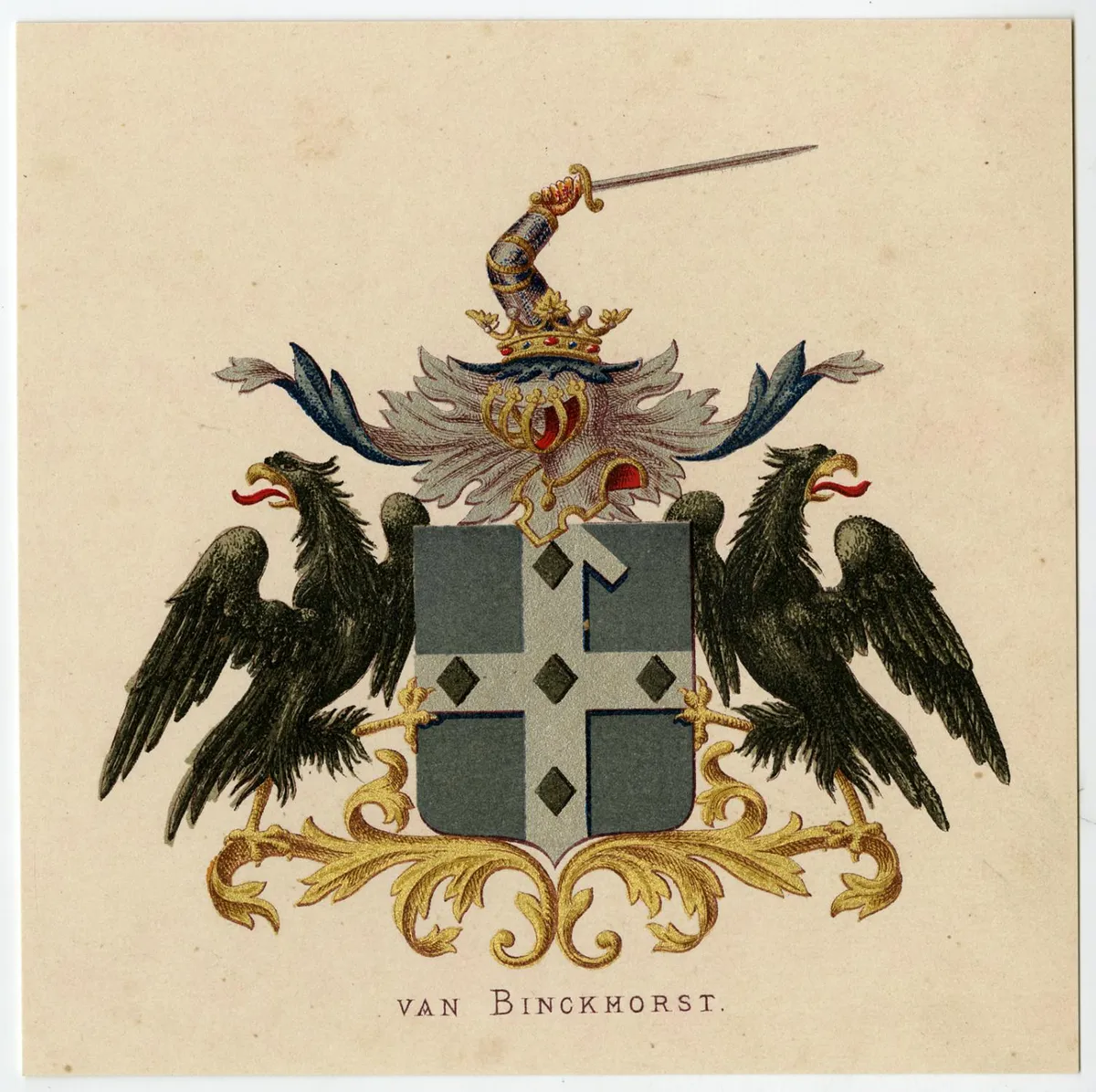
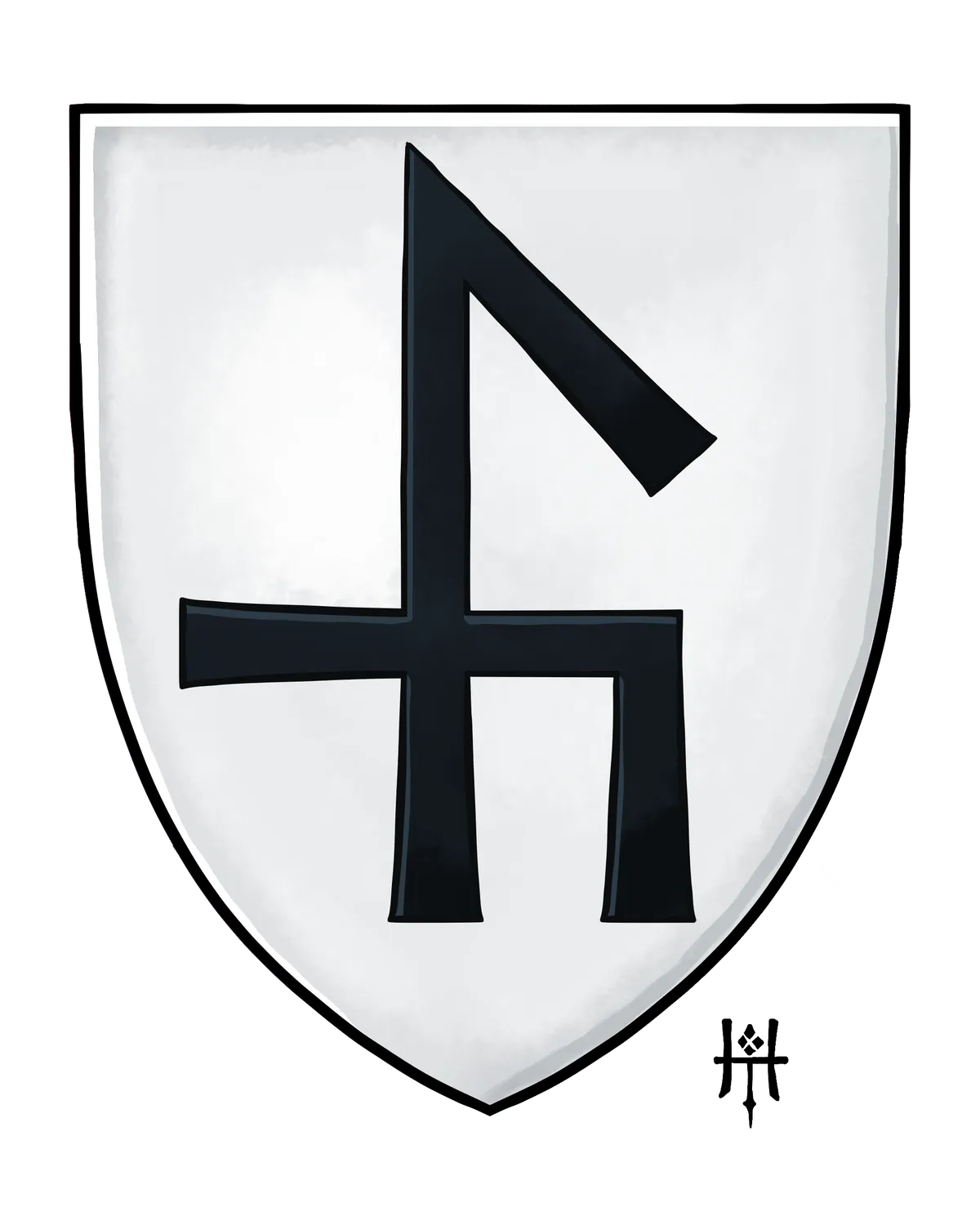
In English blazonry, this corresponds roughly to Azure a cross Argent charged with five lozenges Sable conjoined in sinister chief with a bend couped. The basic design for the arms was clearly copied from the unrelated but identically named noble family from Voorburg whose arms were Argent a cross Gules charged with five lozenges Or.3 The additional branch at the top of the cross is undoubtedly a reference to the house mark utilized by the family which appears on at least two deeds from 1691 next to the signature of "Hermen Binckhorst," who is most likely Herman ten Hengel.2,8 House marks were simple emblems used to denote property, an individual, or a family analogous to coats of arms and used by people of all social classes.


Dutch nobility and the corresponding arms are inherited through the male-line, so with the extinction of the male-line descendants of Johannes Theodorus van Binckhorst in 1912, the arms have also gone extinct. Arms were far from exclusive to the nobility in the Netherlands, and many non-nobles assumed their own arms. Modern Dutch heraldic practice is for non-noble arms to descend to all surname-bearing descendants of the original armiger, or some assigned ancestor.9 Thus, any heraldically-inclined descendants of Gerdt ter Binckhorst who still have the name might reasonably use arms with the house mark alone or as part of a more elaborate design. Dutch and German heraldry, in particular, are full of arms consisting of house marks.
As a final note, I do not speak Dutch, and DeepL has proved a great tool for translating the various records and articles cited throughout.
Genealogical Summary
Gerdt ter Binckhorst, farmer, was born say 1628 and probably died in De Lutte, Overijssel, Netherlands by 7 February 1675, when the notice for his wife's second marriage was published. He married in Oldenzaal, Overijssel, Netherlands 7 February 1658, Stiene Hassinck. She was born say 1633. She married second in Oldenzaal 24 February 1675, Herman ten Hengel.
Children of Gerdt and Stiene (Hassinck) ter Binkhorst, born in De Lutte:
- Hendrick ter Binckhorst, bp. 16 Sept. 1660.
- Jan ter Binckhorst, bp. 12 July 1663.
Johannes Theodorus van Binckhorst and both of my maternal grandparents are descendants of the first son Hendrick ter Binkhorst, each from a different one of his sons.
Nederland's Adelsboek 79 (The Hague: Centraal Bureau Voor Genealogie, 1988):590-594.↩
A. Haga, "Bijdrage tot de genealogie van het Overijsselsche geslacht Bin©khorst," De Nederlandsche Leeuw 57 (1939):508-517.↩
J. B. Rietstap, Wapenboek van den Nederlandschen Adel met Genealogische en Heraldische Aanteekeningen, 2 vols. (Groningen: J. B. Wolters, 1883), 1:26-27; digital images, FamilySearch.↩
Nederlands Hervormde Kerk (Oldenzaal), vol. 263, Births and Marriages, 1641-1685, marriage entry 936, Gerdt ter Binckhorst-Stiene Hassinck, 7 February 1658; digital images, FamilySearch, DGS 7368083 > image 261. Also abstracted by Frank Steggink on Van Papier Naar Digital.↩
Nederlands Hervormde Kerk (Oldenzaal), vol. 263, Births and Marriages, 1641-1685, chronological baptism entries, Hendrick Binckhorst, 16 September 1660; digital images, FamilySearch, DGS 7368083 > image 127. Also abstracted by Frank Steggink on Van Papier Naar Digital.↩
Nederlands Hervormde Kerk (Oldenzaal), vol. 263, Births and Marriages, 1641-1685, chronological baptism entries, Jan ter Binckhorst, 12 July 1663; digital images, FamilySearch, DGS 7368083 > image 135. Also abstracted by Frank Steggink on Van Papier Naar Digital.↩
Nederlands Hervormde Kerk (Oldenzaal), vol. 263, Births and Marriages, 1641-1685, marriage entry 1916, Herman ten Hengel-Stiene ten Binckhorst, 24 February 1675; digital images, FamilySearch, DGS 7368083 > image 308. Also abstracted by Frank Steggink on Van Papier Naar Digital.↩
Hofgericht van de proosdij te Oldenzaal, "Registers van vrijwillige en contentieuse zaken, tevens bevattende aantekeningen betreffende opvaart, versterf, vrijkoop en erfwinning, 1606-1729," inventory 1006, 1606-1694; digital images, Collectie Overijssel (Zwolle), images 163, 166.↩
See, for instance, Nederlands Genootschap voor Heraldiek (Dutch Heraldry Society).↩